
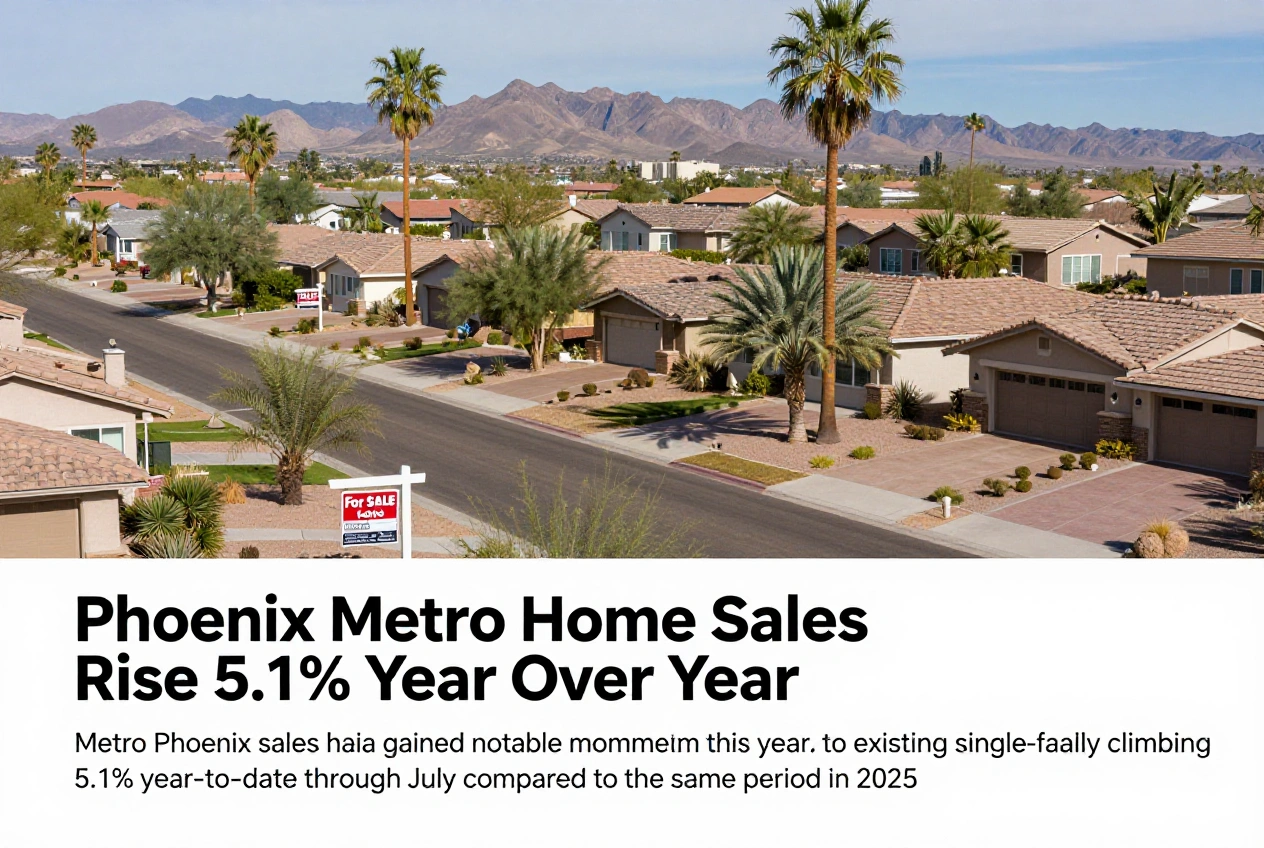
Metro Phoenix Home Sales Rise 5.1% as Buyers and Sellers Adjust to a More Measured Market
Metro Phoenix’s existing single-family home sales increased 5.1% during the first seven months of 2026 compared with the same period last year, according to the latest market activity data from Phoenix REALTORS®.
The increase in closed sales comes alongside nearly flat pending sales and fewer new listings, suggesting that the Phoenix-area housing market remains active but is moving at a more measured pace.
Why This Matters to Phoenix-Area Buyers and Sellers
The latest numbers show that buyers are still completing transactions despite affordability and financing challenges. At the same time, sellers are facing a market where properties may require more time and competitive pricing to attract serious buyers.
Phoenix REALTORS® President Sammy Glassman described the market as continuing to move, but at a slower pace typical of the summer season. He noted that buyers have more time to make decisions while well-priced homes continue to attract serious offers.
Key Metro Phoenix Market Figures
During the first seven months of 2026:
- Existing single-family home sales: increased 5.1% year over year.
- Pending sales: declined 0.6%.
- New listings: declined 2.8%.
- Metro Phoenix median single-family price: approximately $485,000, up 1%.
- Average days on market: increased from 73 to 78 days.
- Sale-to-list price ratio: approximately 98.1%.
- Housing affordability index: 72.
- Inventory: approximately four months of supply, with inventory slightly higher than a year earlier.
Taken together, the figures point to a market with continued sales activity but less urgency than during periods of exceptionally strong buyer competition.
Phoenix and Scottsdale Show Different Trends
Conditions vary considerably between individual markets.
In the city of Phoenix, year-to-date closed sales increased 3.7%. The median single-family home price reached approximately $490,000, up 1% from 2025. Phoenix homes averaged 64 days on market, while inventory stood at approximately 3.4 months of supply, down 5.6% from the same period last year.
Scottsdale recorded stronger sales growth. Year-to-date closed sales increased 13.5%, while the median single-family home price rose 4.1% to approximately $1.26 million.
Scottsdale’s inventory fell to about 3.4 months of supply, down 19% from 4.2 months a year earlier. Pending sales increased 8.2%, although new listings declined 3.2%.
The contrast illustrates why Metro Phoenix statistics should not be applied uniformly to every city or neighborhood.
Maricopa and Pinal Counties Move at Different Paces
The broader regional numbers also vary by county.
Maricopa County recorded a 5.2% increase in year-to-date sales, while pending sales were essentially unchanged and new listings declined 3.2%.
Pinal County showed a different pattern, with closed sales down 0.5%, pending sales down 5.3% and new listings down 5.7%.
These differences reinforce the importance of looking at individual markets when evaluating a potential purchase or sale.
Buyer Interest Remains Stronger Than Closed-Sale Activity
Separate Zillow research provides another indication of buyer interest.
During the second quarter of 2026, Phoenix averaged 3.8 engaged home shoppers per listing, an increase of 19.8% from the previous year. Zillow defines an engaged shopper as a user who saves or shares a for-sale listing, making the metric a measure of stronger online interest rather than simple property views.
However, Zillow also found that higher levels of shopping activity did not translate directly into equivalent increases in completed sales. Nationally, engaged shoppers increased 21.4% year over year, while home sales rose 4.5% during the same spring period. Zillow attributed part of the gap to affordability pressures and mortgage costs keeping some prospective buyers on the sidelines.
What the Numbers Suggest for Buyers
The current market gives buyers somewhat more time to compare properties than during periods of intense competition.
The combination of longer marketing times and relatively stable prices means buyers may have more opportunity to evaluate condition, financing and comparable sales before making an offer.
That does not mean every Phoenix-area property is negotiable or that prices are falling broadly. Scottsdale, for example, continues to show strong year-to-date sales and price growth.
What the Numbers Suggest for Sellers
Sellers continue to have opportunities, but pricing and preparation remain important.
Phoenix REALTORS® says well-prepared homes with competitive prices continue to attract serious buyers. At the same time, the increase in average days on market across the broader region suggests that sellers may need to allow more time for a transaction than they would in a faster-moving market.
Broader Market Context
The Phoenix housing market is showing a combination of higher closed sales, relatively stable prices, longer marketing times and modestly higher inventory.
That combination is more consistent with an active but increasingly balanced market than with either a major housing boom or a broad market downturn.
The differences between Phoenix, Scottsdale, Maricopa County and Pinal County also show why local conditions matter when making real estate decisions.
Key Takeaway
Metro Phoenix existing single-family home sales increased 5.1% year to date through July 2026, while the median price rose about 1% to $485,000.
At the same time, homes were taking longer to sell and buyers had more time to evaluate available properties. Zillow’s data also shows that Phoenix continued to attract meaningful online buyer interest, even though affordability pressures kept some shoppers from completing purchases.
For homeowners, buyers and real estate professionals, the latest data points to a market that is still active but increasingly measured, with meaningful differences from one Phoenix-area community to another.