
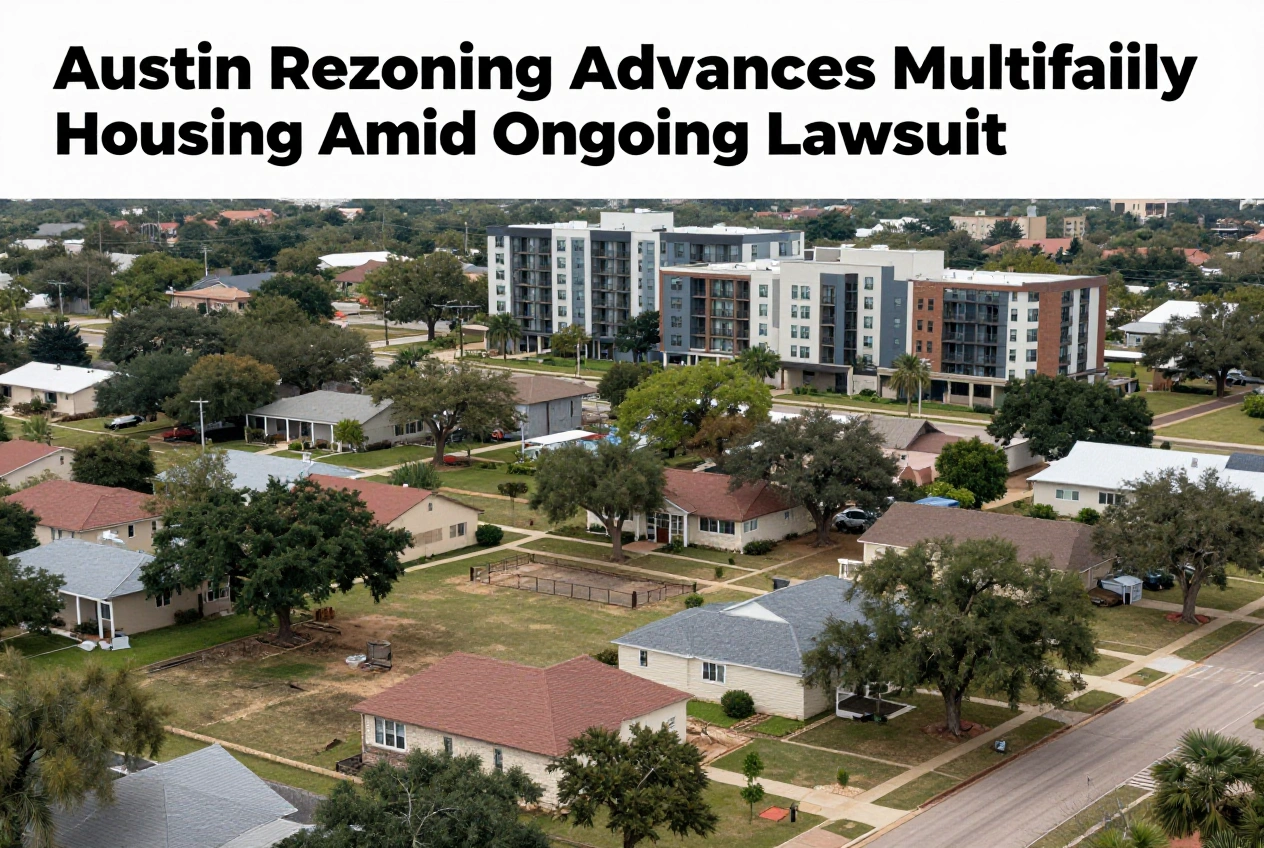
Austin Approves Rosedale Rezoning as Deed-Restriction Lawsuit Continues
Austin City Council has approved a rezoning that could allow a large multifamily development at the former Rosedale School site in Central Austin, while a separate court case over longstanding deed restrictions remains unresolved.
The council voted 10–1 on September 24, 2026, to rezone the Austin Independent School District-owned property at 2117 W. 49th Street and 4709 Rosedale Avenue from single-family residential zoning to MF-6-CO, multifamily residence highest-density conditional overlay zoning. The approved zoning includes a 75-foot height limit.
The proposed redevelopment calls for approximately 435 apartment units on the roughly 4.6-acre former school campus.
Why This Matters to Austin Residents
The rezoning represents a significant change in the development potential of an established Central Austin neighborhood.
For Austin’s housing market, adding hundreds of potential rental units could expand housing options in an area close to existing commercial corridors and future transportation investments. However, the zoning approval does not mean the apartment project can immediately be built.
A separate legal dispute over deed restrictions affecting the property is still pending in Travis County District Court. Austin ISD has said it pursued the lawsuit to obtain legal clarification before completing the sale of the property to developer OHT Partners.
What City Council Approved
The property had previously been zoned SF-3, family residence.
The approved ordinance changes the zoning to MF-6-CO, the city’s highest-density multifamily residential base district with a conditional overlay for the property. City planning staff and the Zoning and Platting Commission had recommended approval.
The rezoning provides the zoning framework needed for the proposed apartment development, but additional development review and permitting would still be required.
The project is being proposed by OHT Partners, which has a pending agreement to purchase the former school property from Austin ISD. Austin ISD says the district’s board authorized negotiations and that a sale contract was subsequently executed, but the transaction remains tied to resolving the property’s legal restrictions.
The Proposed Development
The development plan calls for approximately 435 apartments in a multifamily building.
City records and project materials describe the property as the former Rosedale School site, while community groups have raised concerns about the scale of the proposed development compared with the surrounding neighborhood.
The approved zoning includes a 75-foot height cap, which limits the maximum building height under the rezoning.
The proposal also includes additional development requirements that would be addressed through subsequent review, including transportation, drainage, water-quality and site-planning requirements.
Why the Deed-Restriction Lawsuit Matters
The rezoning decision does not resolve a separate legal question involving 1938 deed restrictions affecting the property.
Austin ISD filed a declaratory judgment lawsuit in October 2025 involving 125 nearby property owners. The district is seeking a court determination concerning whether the proposed residential development is consistent with the restrictions attached to the property.
The restrictions were associated with the original development of the Rosedale subdivision and include limitations concerning the use of the property.
The lawsuit was filed before the proposed sale to OHT Partners could be completed. According to Austin ISD, the district sought the court’s clarification during its due-diligence process because of the legal questions surrounding the property.
Rezoning Does Not Override Private Deed Restrictions
This distinction is particularly important for homeowners and buyers.
The City of Austin explains that zoning and private deed restrictions are separate legal matters. A change in city zoning does not automatically eliminate or invalidate an enforceable private deed restriction.
The city’s Development Services Department states that deed restrictions generally run with the land and that their enforceability is a private legal matter between the parties with rights under the restriction.
That means the council’s rezoning decision does not by itself settle whether the proposed 435-unit project can ultimately proceed under the property’s existing deed restrictions.
Community Concerns and Support
The rezoning has generated significant community discussion.
Some nearby residents have expressed concerns about the scale of the proposed apartment development, particularly potential effects on traffic, neighborhood streets and the character of the surrounding residential area. Community groups have also said they support additional development at the site but favor a smaller-scale approach.
Supporters of the rezoning have emphasized the potential for additional housing in an established part of Austin and the use of previously developed school property for residential purposes.
The City Council ultimately approved the rezoning 10–1, with Council Member Marc Duchen casting the lone opposing vote.
What Happens Next?
The rezoning removes one major land-use obstacle, but several steps remain before the proposed apartment complex could be constructed.
The most significant unresolved issue is the deed-restriction lawsuit between Austin ISD and affected property owners.
The proposed sale to OHT Partners also depends on resolving the legal questions surrounding the property. Austin ISD has stated that the district pursued the court action specifically to clarify whether the proposed residential use is permitted under the historic restrictions.
Additional site-plan review, permitting and compliance with applicable development requirements would also be necessary.
What This Means for Nearby Homeowners
For homeowners near the former Rosedale School site, the council’s decision changes the property’s zoning but does not immediately determine what will ultimately be constructed.
Property owners considering nearby purchases or sales should distinguish between:
- The property’s new city zoning designation;
- The proposed 435-unit development plan;
- The unresolved private deed-restriction litigation; and
- Any future site-plan and development approvals.
These are separate stages of the process and could affect the project’s eventual form and timeline.
Broader Austin Housing Context
The Rosedale case illustrates one of the challenges facing rapidly growing cities such as Austin: increasing housing capacity while navigating neighborhood concerns, private property restrictions and existing infrastructure.
Austin has increasingly considered higher-density development near established neighborhoods and transportation corridors. At the same time, individual projects can still face legal and regulatory issues that determine whether zoning changes ultimately translate into construction.
The Rosedale project is therefore an example of how zoning approval does not necessarily equal immediate development.
Key Takeaway
Austin City Council’s 10–1 vote on September 24, 2026 approved multifamily zoning for the former Rosedale School site, allowing a framework for a proposed 435-unit apartment development with a 75-foot height limit.
However, the project is not yet cleared for construction. A separate lawsuit involving decades-old deed restrictions remains unresolved, and the city’s own guidance confirms that zoning changes do not automatically eliminate private deed restrictions.
For nearby homeowners, prospective buyers and real estate professionals, the next major development to watch is the outcome of the deed-restriction case and any subsequent development approvals.