
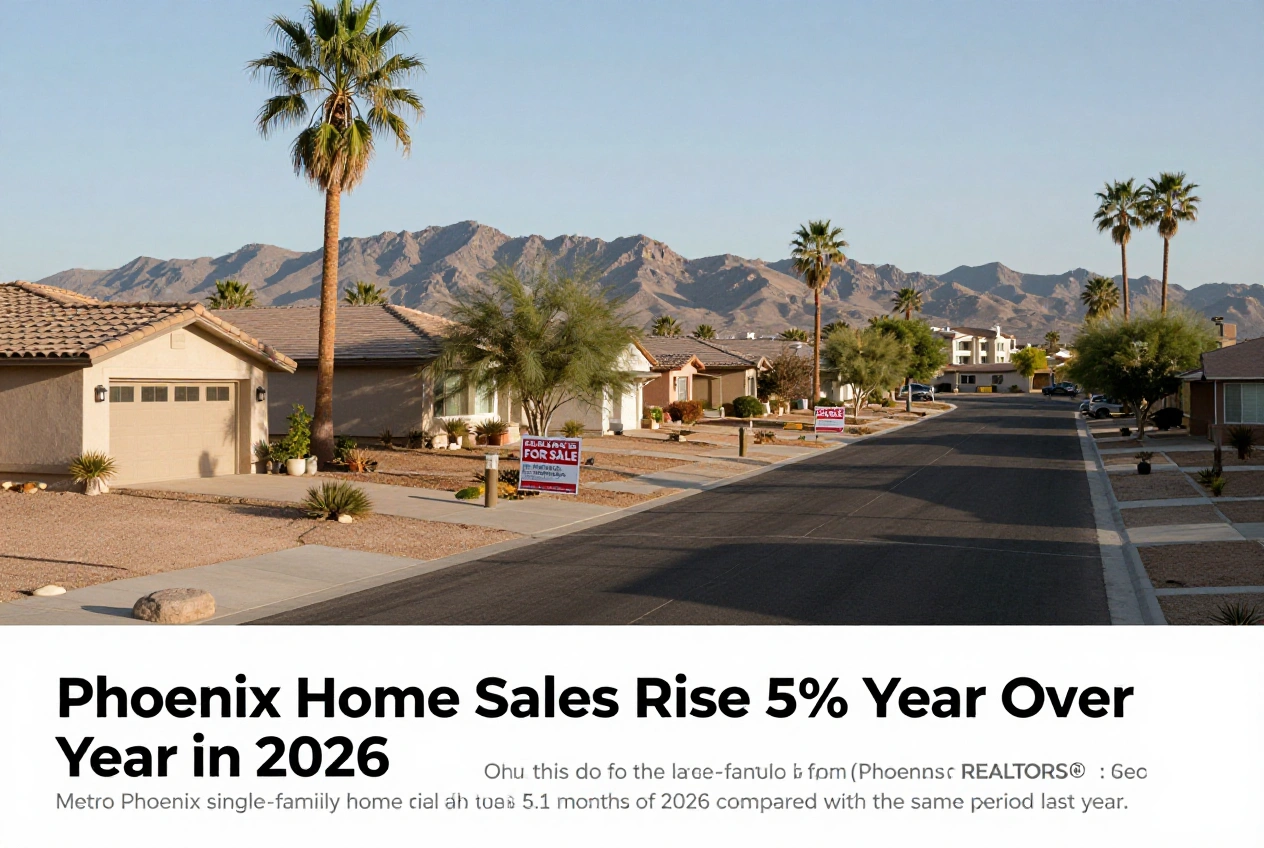
Metro Phoenix Home Sales Rise 5.1% as Market Moves at a More Measured Pace
Existing single-family home sales in Metro Phoenix increased 5.1% during the first seven months of 2026 compared with the same period last year, according to the latest market activity data from Phoenix REALTORS®, based on Arizona Regional Multiple Listing Service (ARMLS) data.
At the same time, pending sales were nearly flat, while new listings declined. The combination suggests that the Phoenix-area housing market remains active but is moving at a more measured pace as buyers and sellers adjust to current pricing, inventory and affordability conditions.
Why This Matters to Phoenix-Area Buyers and Sellers
The increase in closed sales shows that transactions are continuing despite affordability pressures and borrowing costs.
However, the market is not moving at the same pace across every community. Buyers have more time to evaluate properties in many areas, while sellers may need to price competitively to attract serious offers.
Phoenix REALTORS® President Sammy Glassman said the summer is typically the slowest period for home sales and characterized the current market as one that is still moving, but at a more measured pace.
Key Metro Phoenix Market Figures
For the first seven months of 2026:
- Existing single-family home sales: up 5.1% year over year.
- Pending sales: down 0.6%.
- New listings: down 2.8%.
- Median single-family sales price: approximately $485,000, up 1%.
- Average days on market: increased from 73 to 78 days, a 6.8% increase.
- Sale-to-list price ratio: approximately 98.1%.
- Housing affordability index: 72.
- Inventory: approximately a four-month supply, up about 1.3% from the prior year.
The numbers point to a market with more breathing room than during the highly competitive periods of recent years, while prices remain relatively stable.
Phoenix and Scottsdale Show Different Market Conditions
The broader Metro Phoenix numbers also mask differences between individual communities.
In the city of Phoenix, year-to-date closed sales increased approximately 3.7%, while the median single-family sales price reached about $490,000, up 1% from the previous year. Phoenix had approximately 64 days of supply-related market time and about 3.4 months of inventory during the reporting period.
Scottsdale recorded stronger sales activity, with year-to-date closed sales increasing approximately 13.5%. Its median single-family price reached approximately $1.26 million, representing a 4.1% increase, while inventory stood at about 3.4 months of supply.
These differences illustrate why buyers and sellers should look beyond the broader Metro Phoenix number when evaluating a specific neighborhood or property.
Maricopa and Pinal Counties Move Differently
The county-level figures also show a divergence within the region.
Maricopa County recorded year-to-date closed sales growth of approximately 5.2%, with pending sales essentially flat and new listings down 3.2%.
In Pinal County, closed sales declined approximately 0.5%, while pending sales fell 5.3% and new listings declined 5.7%.
That variation suggests that market conditions can differ substantially depending on location, price range and local inventory.
Buyer Interest Remains Present
Separate Zillow research provides another view of buyer activity.
During the second quarter of 2026, Phoenix had approximately 3.8 engaged home shoppers per listing, an increase of 19.8% from the previous year. Zillow defines an engaged shopper as a user who saves or shares a for-sale listing, which is intended to capture stronger interest than simply viewing a property online.
However, strong online interest does not necessarily translate directly into completed purchases. Zillow noted that affordability and borrowing costs continued to keep some prospective buyers on the sidelines nationally.
What the Market Is Signaling
The combination of higher closed sales, relatively stable prices, longer marketing times and additional inventory suggests a market that is becoming more balanced and less urgent for many buyers.
For sellers, the data indicates that pricing remains important. Homes that are priced competitively can still attract buyers, but sellers may need to allow more time for a transaction than they would have during the fastest periods of the market.
For buyers, the increase in market time and inventory can provide more opportunities to compare properties and negotiate, although competition remains stronger in some neighborhoods and price ranges.
What Buyers and Sellers Should Watch This Fall
Several indicators will be important as the market moves through the remainder of 2026:
- Whether closed sales continue to grow year over year.
- Whether inventory continues increasing.
- Whether median prices remain relatively stable.
- How quickly homes are moving from listing to contract.
- Whether mortgage rates change buyer purchasing power.
- How conditions differ between Phoenix, Scottsdale and surrounding communities.
The broader market data currently points toward continued activity rather than a sharp downturn, but conditions remain uneven across the region.
Key Takeaway
Metro Phoenix existing single-family home sales were 5.1% higher year to date through the first seven months of 2026, while the median sales price increased only about 1% to $485,000.
At the same time, homes were taking longer to sell and inventory remained around four months of supply. Together, those figures suggest that Phoenix’s housing market is active but more measured and balanced than in previous high-demand periods.
For homeowners, buyers and real estate professionals, the most useful takeaway is that the overall market is moving forward—but local conditions matter. Phoenix, Scottsdale, Maricopa County and Pinal County are not experiencing exactly the same level of activity.