
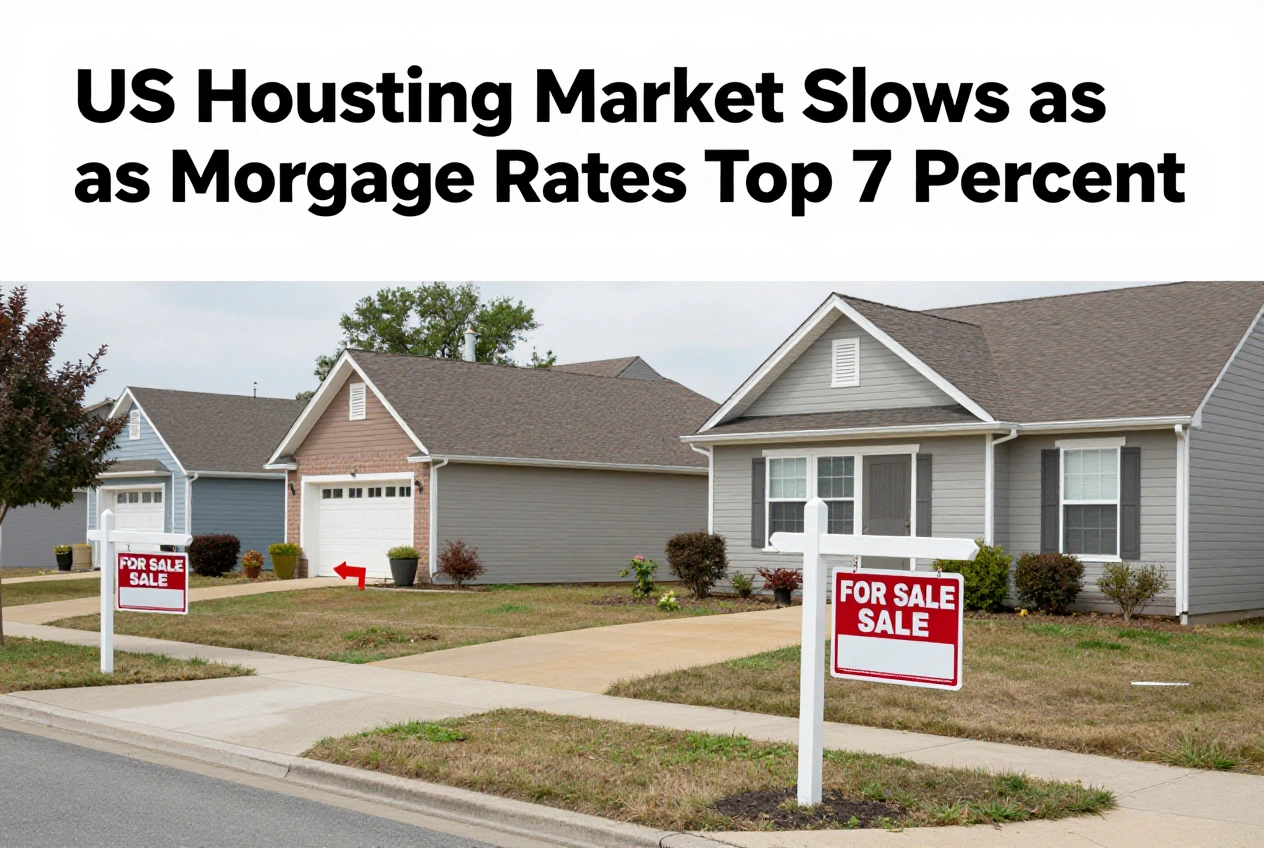
U.S. Housing Market Slows as Mortgage Rates Rise and Price Cuts Increase
The U.S. housing market showed signs of slowing in late summer and early fall as elevated mortgage rates weighed on buyer activity, while growing inventory gave buyers more options and encouraged more sellers to reduce asking prices.
The latest data present a mixed picture: existing-home sales declined in August, September listings increased, and mortgage rates ended the month at their highest level since late 2023.
Existing-Home Sales Decline in August
Existing-home sales fell 2.0% in August to a seasonally adjusted annual rate of 3.98 million homes, according to the National Association of REALTORS® (NAR).
Sales were also 1.2% below August 2025, marking another month of relatively subdued activity. NAR reported that the last time existing-home sales fell below a 4 million annualized pace was June 2025. (nar.realtor)
The decline came despite some improvement in housing supply. NAR reported 1.62 million existing homes available for sale in August, equivalent to 4.9 months of supply, the highest level in more than a decade. (nar.realtor)
Mortgage Rates Remain a Major Affordability Challenge
Mortgage rates remained elevated through September.
Freddie Mac reported that the average 30-year fixed mortgage rate reached 7.28% at the end of September, its highest level since November 2023. Zillow noted that rates had climbed significantly during September, adding pressure to monthly housing payments. (freddiemac.com)
Zillow estimated that the monthly mortgage payment on a typical U.S. home was 6.7% higher than a year earlier, assuming a 20% down payment and excluding taxes and insurance. (zillow.com)
Higher rates do not necessarily prevent buyers from entering the market, but they can reduce purchasing power and make prospective homeowners more cautious about taking on a mortgage.
Inventory Is Moving Closer to Pre-Pandemic Levels
September data from Realtor.com showed 1,161,615 active listings nationwide, up 5.4% from a year earlier.
Although inventory remained below typical pre-pandemic levels, the gap narrowed to about 9.1% below the 2019 benchmark, the smallest shortfall recorded in the Realtor.com series since the pandemic-era housing disruption. (realtor.com)
More available homes can give buyers additional choices and reduce the urgency that characterized some of the tightest housing markets in recent years.
More Sellers Are Cutting Prices
The September Realtor.com data also showed an increase in price reductions.
About 20.8% of active listings had their asking prices reduced during September, up 0.9 percentage points from a year earlier. Realtor.com said this was the highest September share since 2018 and the highest reading for any month since October 2022. (realtor.com)
The national median listing price was $419,250, down 1.4% from September 2025 and 1.2% from August.
This suggests that sellers in some markets are becoming more willing to adjust expectations as buyers contend with higher financing costs.
New-Home Sales Rebounded in August
The new-construction market showed a somewhat different pattern.
According to the U.S. Census Bureau and Department of Housing and Urban Development, sales of new single-family homes increased 6.4% in August from July to a seasonally adjusted annual rate of 684,000.
However, August sales remained 2.0% below August 2025.
The supply of new homes stood at approximately 483,000 units, representing 8.5 months of supply at the August sales pace. The median price of a new home sold in August was $393,700, down 5.8% from a year earlier. (census.gov)
The rebound in monthly new-home sales therefore does not necessarily signal a broad recovery in housing demand, particularly given the year-over-year decline and elevated supply.
Pending Sales Point to Continued Caution
September’s forward-looking indicators also showed weaker demand.
Zillow reported that newly pending home sales fell 8.5% year over year in September and 11.2% from August. Newly pending sales measure homes that moved from active listing to pending status and can provide an early indication of future closed sales. (zillow.com)
That decline, combined with higher mortgage rates and increased price reductions, suggests that buyers remained cautious entering the fall market.
What This Means for Buyers
For buyers who can comfortably afford today’s mortgage rates, the market may offer more negotiating opportunities than during periods of severe inventory shortages.
More listings and a greater share of price reductions can give buyers additional choices. However, buyers should evaluate the full monthly cost of ownership, including mortgage payments, property taxes, homeowners insurance, HOA fees and maintenance.
Comparing multiple lenders and loan options may also help buyers determine what fits their budget.
What This Means for Sellers
Sellers may face a more selective buyer pool than in recent years.
With more homes available and price reductions becoming more common, realistic pricing can be increasingly important. Sellers should consider recent comparable sales, competing listings and local market conditions rather than relying solely on previous peak prices.
Marketing time may also vary considerably by location and property type.
Key Takeaway
The latest national housing data point to a slower and more balanced market, rather than a uniform decline in home values.
Existing-home sales fell in August, while September brought more inventory and a higher share of price reductions. Mortgage rates ending the month at 7.28% continued to put pressure on affordability, while new-home sales provided a partial counterpoint by rebounding from July. (nar.realtor)
For buyers, increased inventory may create more room to negotiate. For sellers, competitive pricing and realistic expectations are becoming increasingly important as the market adjusts to higher borrowing costs.