
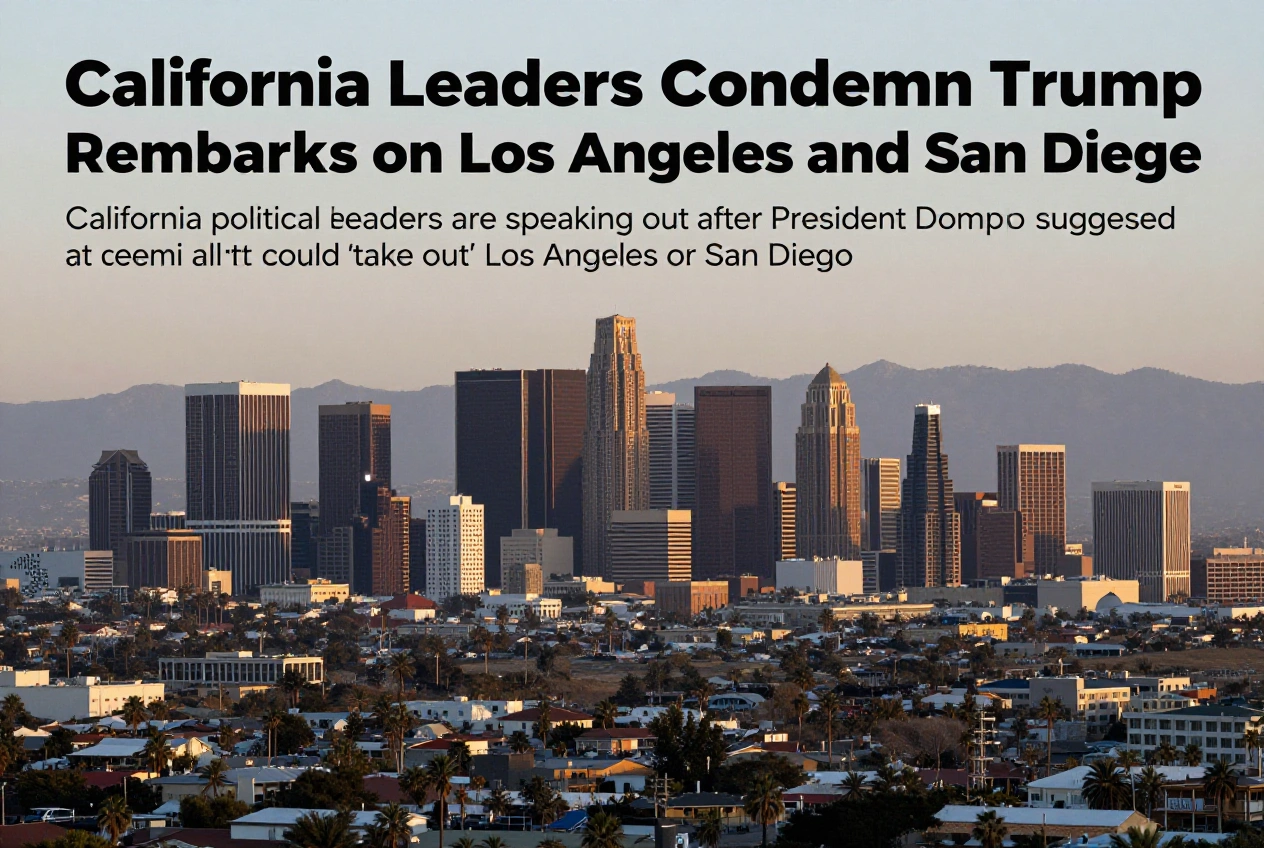
California Leaders Respond After Trump Remarks About Los Angeles and San Diego
California officials are responding after President Donald Trump made remarks at a campaign rally suggesting that Iran could “take out” Los Angeles or San Diego while discussing the ongoing U.S.-Iran conflict.
Trump made the comments on October 5, 2026, during a rally in Grand Island, Nebraska. His remarks quickly drew criticism from California state and local officials, while the White House later said he was describing the threat that could have existed if Iran had been allowed to develop nuclear capabilities.
Why This Matters to California Residents
Los Angeles and San Diego are two of California’s largest metropolitan areas. San Diego is also home to major U.S. military installations.
The comments have therefore drawn attention not only because of their political implications, but also because of questions about how public statements involving potential attacks on major American cities could affect public perceptions of safety.
California officials have emphasized that they are taking the remarks seriously. On October 6, Gov. Gavin Newsom said he was directing the State Threat Assessment Center to actively monitor the situation in case foreign actors interpreted Trump’s comments as an invitation to target California.
What Trump Said
While discussing the economic impact of the war with Iran, including higher gasoline prices, Trump argued that the costs were a relatively small price for protecting the United States and the world.
He then said that Iran could “take out” a city and specifically named Los Angeles and San Diego. The comments were made during a broader campaign speech in which Trump discussed the war, energy prices and national security.
The wording prompted immediate questions about what Trump intended to convey.
The White House later said Trump was not calling for Iran to attack American cities. White House Communications Director Steven Cheung said the president was explaining that the United States was acting to prevent Iran from acquiring the capability to threaten cities such as Los Angeles and San Diego.
FactCheck.org similarly noted that the wording was confusing but concluded that the broader context and subsequent White House explanation supported interpreting the remarks as an argument for preventing a future Iranian threat rather than an invitation for Iran to attack U.S. cities.
California Officials React
Gov. Gavin Newsom strongly criticized the remarks, saying they were dangerous and that they placed a target on two major California cities and a major naval hub. He also announced that the State Threat Assessment Center would monitor the situation.
Los Angeles Mayor Karen Bass also criticized Trump’s comments, saying the president’s role should be to protect Americans and that the remarks could compromise public safety.
San Diego Mayor Todd Gloria said San Diego should not be treated as collateral damage and also objected to the president’s characterization of a potential attack on the city.
The reaction was not limited to Democrats. Reuters reported that some California Republicans also criticized or distanced themselves from the comments, including Republican congressional candidate Jim Desmond and Rep. Kevin Kiley.
Trump Later Clarifies His Position
On October 7, Trump returned to the issue at a rally in Texas and said he would not allow Iran to attack Los Angeles or San Diego.
His later comments were intended to make clear that he did not want such an attack to occur, following two days of criticism over his earlier remarks.
National Security Context
The comments come amid the ongoing U.S.-Iran conflict and broader concerns about Iran’s nuclear and missile capabilities.
However, the remarks themselves do not establish that Iran has an active plan to attack Los Angeles or San Diego. The Los Angeles Times reported that it was unclear whether Trump’s comments were based on specific intelligence and noted questions surrounding Iran’s ability to conduct a long-range missile attack against the continental United States.
California authorities’ decision to monitor the situation therefore should not be interpreted as confirmation of an imminent attack. It reflects officials’ stated response to the president’s remarks and the possibility that foreign actors could interpret public statements in different ways.
California’s 2026 Election Context
The controversy is also unfolding during California’s 2026 gubernatorial election season.
The state’s official voter information identifies Xavier Becerra, a Democrat, and Steve Hilton, a Republican, as the two candidates for governor in the November 3, 2026, general election.
However, polling and campaign predictions are separate from the security issue itself. For this article, the most relevant development is that the Trump remarks have become part of the broader political discussion surrounding California’s relationship with the federal government.
What Residents Should Know
At this time, the verified developments are:
- Trump made the comments at a Nebraska campaign rally on October 5.
- Los Angeles and San Diego were specifically named.
- California state and local officials publicly criticized the remarks.
- Newsom directed the State Threat Assessment Center to monitor the situation.
- The White House said Trump was discussing the potential threat that could have existed if Iran developed greater nuclear capabilities.
- Trump subsequently said he would not allow Iran to attack Los Angeles or San Diego.
- There is no verified evidence in the sources reviewed that Iran has announced or launched a planned attack against either city.
Key Takeaway
The controversy centers on the wording of Trump’s October 5 remarks and the different interpretations that followed.
California officials treated the comments as a serious public-safety concern, while the White House said Trump was describing the potential consequences of failing to prevent Iran from developing a nuclear threat. Trump’s later statement that he would not allow attacks on Los Angeles or San Diego further clarified his stated position.
For California residents, the important distinction is between political rhetoric about a hypothetical threat and verified information about an actual attack or imminent threat. No such attack has been reported in the sources reviewed.