
Arizona HOA Law Changes Protect Backyard Shade Structures and Expand Homeowner Disclosures
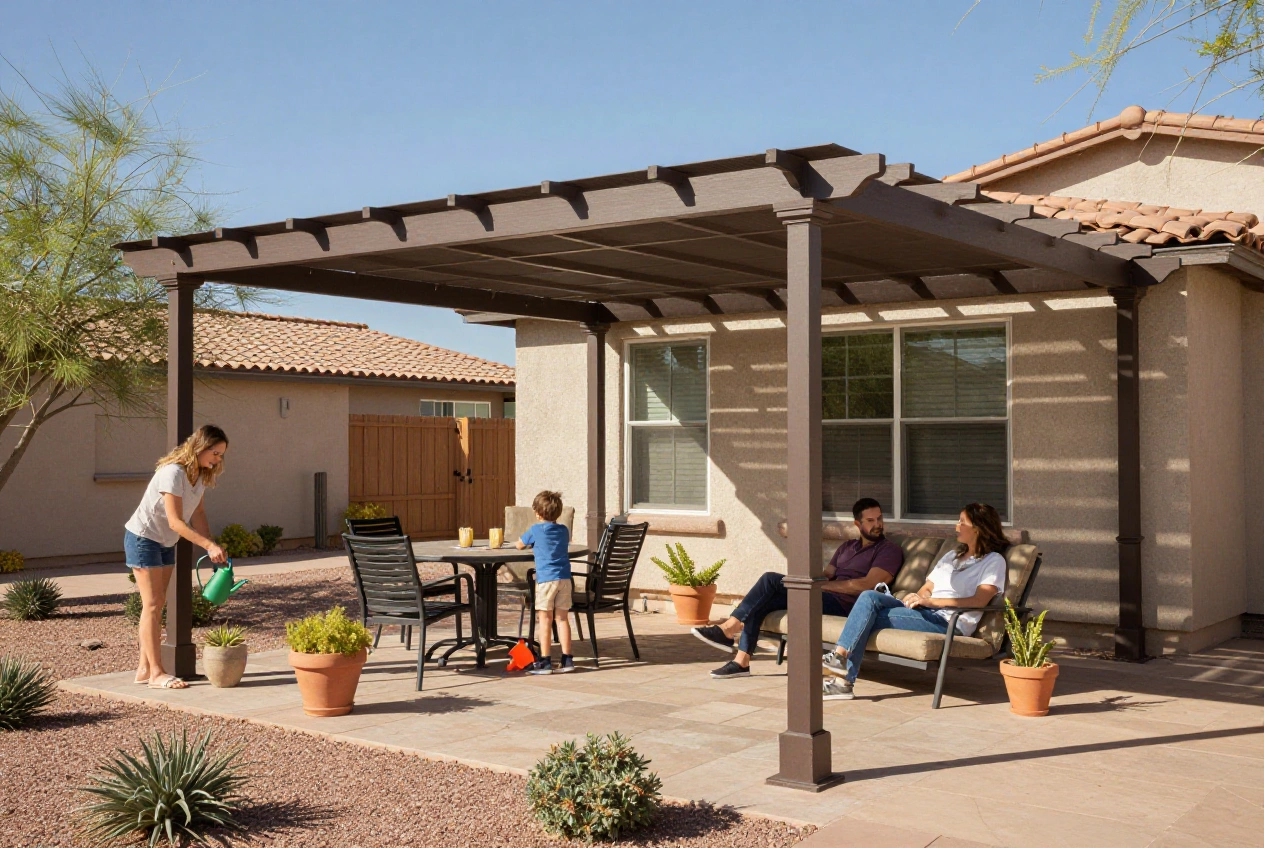
Arizona homeowners in planned communities gained new protections on September 12, 2026, when a series of state laws took effect. One of the changes prevents homeowners associations (HOAs) from banning qualifying backyard shade structures, including umbrellas, awnings, gazebos, pergolas and canopies.
The shade-structure law is part of a broader set of reforms affecting HOA governance, condominium assessment liens and real estate resale disclosures. Together, the changes clarify certain homeowner rights and establish updated requirements for associations and property transactions.
New Law Limits HOA Restrictions on Backyard Shade
House Bill 2342 added A.R.S. § 33-1816.01 to Arizona law. It prohibits planned-community associations from banning the installation or use of qualifying shade structures in backyards, even when existing community documents contain conflicting restrictions.
The law covers commercially produced or professionally manufactured movable or permanent structures designed to protect an area from sunlight. Examples include umbrellas, awnings, shade sails, gazebos, pergolas and canopies.
Associations may still establish reasonable rules governing a structure’s size, placement or appearance. However, those rules cannot prevent installation, impair the structure’s function, restrict its use or unreasonably affect its cost. Restrictions also cannot be more stringent than the applicable municipal zoning requirements for height and setbacks for a single-family home.
The law does not eliminate every HOA design restriction, nor does it apply automatically to all property types. Its specific protection concerns backyard shade structures in Arizona planned communities.
What the Change Means for Homeowners and Buyers
The new law may help homeowners who previously encountered HOA restrictions on adding shade to their backyards. In Arizona’s hot climate, shade structures can make outdoor spaces more comfortable and usable for much of the year.
Homeowners should review their association’s current rules and determine whether a proposed structure falls within the law’s definition. They should also check applicable municipal zoning requirements and any other relevant safety or permitting rules.
For prospective buyers, understanding an HOA’s authority and restrictions remains an important part of evaluating a property. Buyers should review the association’s governing documents and disclosure materials rather than assume that every existing restriction is invalid under the new law.
The change may also be relevant to sellers marketing homes with outdoor living areas. However, it does not guarantee a higher property value or greater buyer demand.
Other Arizona HOA Reforms Took Effect in September
The shade-structure law is only one part of Arizona’s 2026 HOA-related legislation. Several other measures took effect on September 12, addressing association governance, foreclosure thresholds and resale disclosures.
Boards Must Exercise Discretion Fairly
A separate 2026 law established an express duty for condominium and planned-community associations to exercise discretionary powers reasonably, neutrally, fairly, without favoritism and in a non-arbitrary manner.
The provision addresses how associations exercise their authority when making decisions or enforcing rules. It does not prevent associations from enforcing valid governing documents, but it sets standards for how discretionary decisions should be made.
Homeowners who believe an association has applied a rule inconsistently should document the relevant decisions and review the association’s governing documents and applicable legal requirements.
Condominium Foreclosure Thresholds Changed
Senate Bill 1246 increased the threshold for condominium associations seeking to foreclose a common-expense lien for unpaid assessments. Under the revised law, foreclosure may generally proceed when an owner remains delinquent for 18 months or owes at least $10,000 in assessments, whichever occurs first, subject to the law’s specific provisions.
For certain special assessments initially valued at $10,000 or more, the 18-month delinquency threshold applies.
This change primarily affects condominium associations. Arizona planned-community HOAs already had an $10,000 or 18-month threshold under prior law, so the measure should not be described as a new, identical increase for every HOA.
The revised threshold does not eliminate an owner’s obligation to pay assessments or prevent an association from pursuing other legally available collection methods.
Resale Disclosure Requirements Have Expanded
House Bill 2397 updated Arizona’s resale-disclosure requirements for both condominiums and planned communities.
The legislation revises the information that must be provided to prospective purchasers and adjusts the process for delivering disclosure materials. Requirements differ depending on factors such as the type of property and the size of the association.
The changes make accurate and timely disclosure important for sellers, associations and real estate professionals. Buyers should carefully review the applicable disclosure packet, including assessment information, association documents and other required records, before completing a purchase.
Arizona REALTORS® Updates HOA Transaction Forms
The Arizona Association of REALTORS® announced another revision to its HOA and condominium transaction form for use beginning around November 1, 2026.
The updated form addresses concerns about inaccurate or incomplete disclosure of association fees during real estate transactions. The revisions clarify how fees and dues are presented and how buyers and sellers allocate certain charges in a purchase offer.
The association recommends that real estate professionals use current forms and ensure that the information supplied during a transaction is accurate.
These form changes are separate from the shade-structure law. They reflect the practical adjustments needed as Arizona’s disclosure requirements and transaction practices evolve.
What Homeowners, Buyers and Sellers Should Do
Arizona homeowners should review their association’s current policies to understand how the new shade-structure protection applies to their property. If an HOA rejects a proposed structure, homeowners may wish to request the specific rule and compare it with A.R.S. § 33-1816.01 and applicable local zoning requirements.
Buyers and sellers should also pay attention to updated HOA disclosure procedures, fee information and governing documents during a transaction. Associations and property managers should review their policies to ensure they reflect the applicable statutory changes.
Because these laws address different subjects and may apply differently to planned communities and condominiums, legal advice may be useful when a dispute or transaction-specific question arises.
Arizona’s 2026 reforms provide clearer standards in several areas of HOA governance and real estate transactions. Their practical impact will depend on how associations implement the changes and how homeowners, buyers, sellers and professionals apply the updated requirements.