
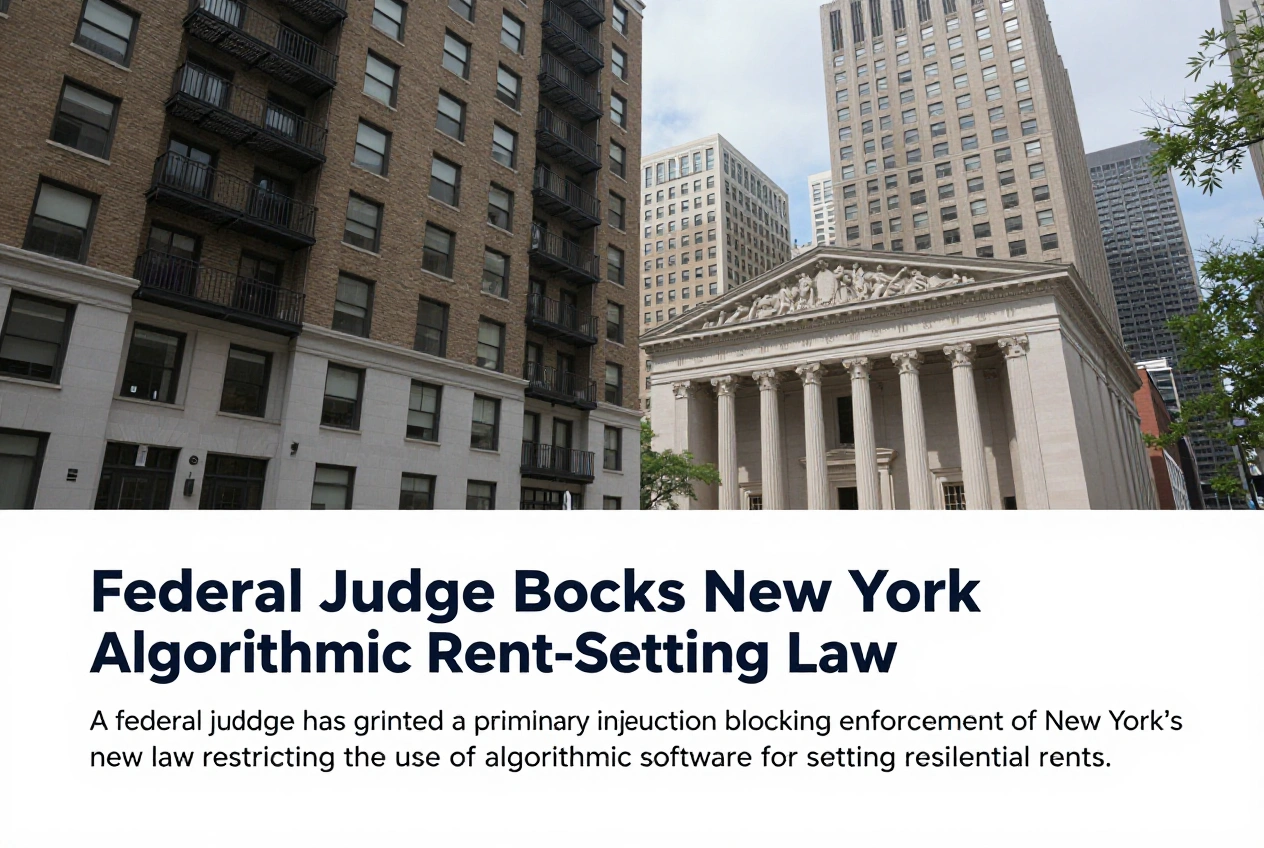
Federal Judge Blocks Part of New York Algorithmic Rent Law in RealPage Case
A federal judge has temporarily blocked enforcement of part of New York’s law governing algorithmic rental pricing, allowing RealPage to continue challenging the statute in court.
U.S. District Judge Valerie E. Caproni of the Southern District of New York issued the preliminary injunction on September 29, 2026, in a lawsuit brought by RealPage against New York Attorney General Letitia James. The court also denied the attorney general’s motion to dismiss the case.
The ruling does not invalidate New York’s entire law or establish that RealPage’s pricing practices are lawful. Instead, it temporarily prevents enforcement of Section 340-B(3) while the constitutional challenge proceeds.
Why This Matters to New York Landlords and Renters
New York’s law addresses agreements among residential rental owners and managers that can reduce competition, including arrangements involving software, data analytics and algorithmic tools.
The RealPage lawsuit challenges the law on constitutional grounds. Judge Caproni found that RealPage was marginally likely to succeed on its First Amendment claim concerning the provision covered by the injunction.
For property owners and managers, the decision provides temporary relief from enforcement of that specific provision while the litigation continues.
For renters, however, the ruling does not immediately mean that rents will increase or decrease. The court’s decision concerns the enforceability of a particular provision of the law, not the actual level of rents in New York.
What the New York Law Addresses
New York enacted restrictions addressing certain agreements among residential rental owners and managers involving the use of pricing information and technology.
The law was part of the state’s broader effort to address practices that could reduce competition in rental housing markets.
The RealPage lawsuit challenges the constitutionality of the provision at issue rather than asking the federal court to decide the broader question of whether algorithmic pricing can violate antitrust law.
That distinction is important because the New York constitutional case and the separate federal antitrust litigation involving RealPage are related but legally different matters.
What the Preliminary Injunction Does
The court’s order specifically states that enforcement of New York General Business Law § 340-B(3) is preliminarily enjoined. It does not strike down Section 340-B in its entirety.
A preliminary injunction is also not a final decision on the merits.
The court’s finding that RealPage is marginally likely to succeed on its First Amendment claim means the company cleared the standard required for temporary relief. The underlying legal questions will still need to be resolved as the case proceeds.
How This Differs From the Federal Antitrust Case
The New York case should not be confused with the separate federal antitrust litigation brought by the U.S. Department of Justice and several states.
In that case, the government alleges that RealPage’s software used nonpublic, competitively sensitive information supplied by landlords and incorporated features that could limit rent decreases or align pricing among competing properties. RealPage has disputed the government’s allegations.
The federal antitrust litigation has produced several settlements and proposed settlements involving RealPage and major property managers.
For example, the Justice Department’s 2026 enforcement activity includes agreements involving Greystar, LivCor, Willow Bridge and Pinnacle, with provisions addressing the use of competitors’ sensitive data and certain algorithmic pricing practices.
Those developments are separate from the constitutional challenge to New York’s law.
What This Could Mean for Property Managers
For New York property managers and landlords, the immediate effect is that enforcement of the specifically challenged statutory provision is temporarily blocked while the lawsuit continues.
However, the ruling should not be interpreted as a broad authorization to use any type of algorithmic pricing system.
Property owners and managers may still be subject to federal antitrust requirements, other state and local laws, fair-housing rules and contractual obligations.
Because the legal landscape is developing quickly, businesses using automated rent-setting or revenue-management software should review their practices with qualified legal counsel.
What Happens Next?
The RealPage lawsuit will continue in federal court.
The court has scheduled an initial pretrial conference for October 30, 2026, with the parties required to make additional submissions before that hearing.
The preliminary injunction could eventually be modified, extended or replaced by a final ruling after the court considers the underlying claims.
Meanwhile, the separate federal antitrust litigation continues to develop, creating an evolving regulatory environment for algorithmic pricing in the rental housing industry.
Key Takeaway
The September ruling represents an important—but limited and temporary—development in the debate over algorithmic rent-setting.
A federal judge has blocked enforcement of one provision of New York’s law while RealPage challenges it on First Amendment grounds. The ruling does not invalidate the entire statute, does not establish that RealPage’s business practices comply with antitrust law and does not directly determine what landlords may charge for rent.
For property owners, managers and investors, the broader lesson is that algorithmic pricing remains an area of significant legal scrutiny. Keeping track of both state regulations and federal antitrust developments will be important as these cases move forward.