
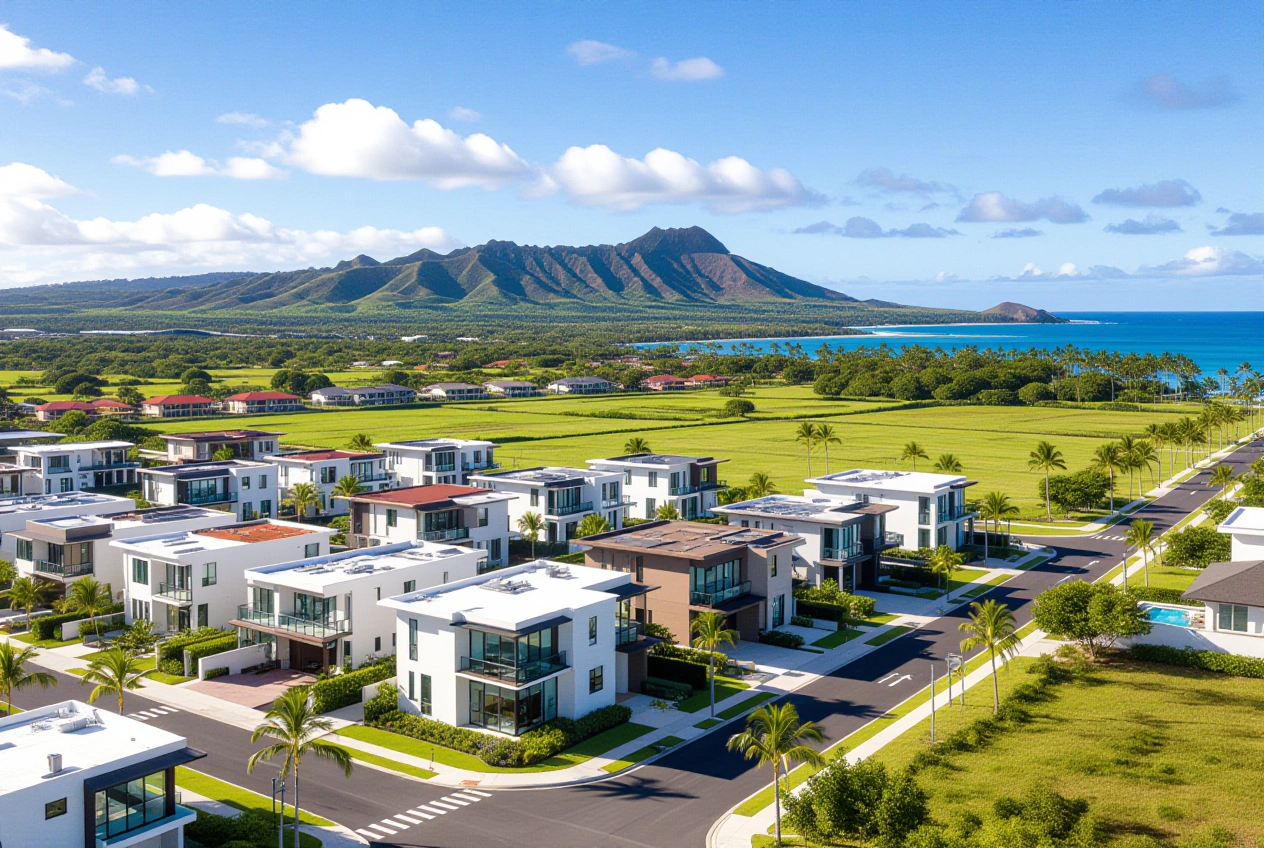
Oʻahu Continues to See Major Housing Development as Communities Plan for Growth
Oʻahu continues to see significant housing development, particularly in growing communities such as Kapolei and the broader ʻEwa region. At the same time, the latest state economic data shows that Hawaiʻi’s construction market remains mixed, making it important to distinguish between individual development projects and broader statewide construction trends.
Development Continues in Kapolei and West Oʻahu
Kapolei remains an important center for residential growth.
Honolulu officials recently discussed plans for an 800-unit affordable rental development along Kapolei Parkway. The project is expected to target households earning between 60% and 80% of the area’s median income, with groundbreaking anticipated in late 2026 or early 2027. Construction is expected to take approximately three to four years and will be completed in phases.
Another major project, Leiwili Kapolei, represents the final village within the existing Villages of Kapolei master plan. The development could ultimately add approximately 900 housing units, including affordable and workforce housing.
These projects demonstrate that West Oʻahu remains an important area for future housing growth.
Construction Activity Is Mixed
Although major projects are moving forward, statewide construction data does not support describing Hawaiʻi’s construction industry as being in an unprecedented boom.
According to the Hawaiʻi Department of Business, Economic Development & Tourism (DBEDT), construction employment increased by 3% in the first quarter of 2026, adding approximately 1,200 jobs compared with the same period in 2025.
However, private building authorizations declined significantly during the same period. Statewide private building authorizations decreased by 33.5%, while Honolulu County experienced a 41.6% decline compared with the first quarter of 2025.
This suggests that while large housing developments remain active, the overall construction market is experiencing both growth and challenges.
Housing Costs and Development
Construction costs also remain an important consideration for developers.
DBEDT reported that the Honolulu Construction Cost Index increased 6.3% for single-family residences and 6.1% for high-rise buildings in the first quarter of 2026 compared with the previous year.
At the same time, Honolulu’s housing market remains expensive. The median price for single-family resale homes reached $1.18 million in the first quarter of 2026, an increase of 2.6% from the same period in 2025.
These conditions help explain why affordable and workforce housing projects continue to be an important part of Oʻahu’s development pipeline.
What New Development Means for Communities
New housing can bring significant benefits to growing communities, including additional housing choices, new infrastructure, and increased access to services and amenities.
However, rapid development can also create challenges for existing communities.
For homeowners associations and community managers, nearby development can affect:
- Traffic and transportation patterns
- Landscaping and common-area maintenance
- Water and wastewater infrastructure
- Parks and recreational facilities
- Community amenities
- Property values and neighborhood demand
- Long-term capital and maintenance planning
HOA boards may also need to consider how future development could affect community facilities and the demand for services.
What Homeowners Should Watch
Homeowners living in or near developing areas should pay attention to local planning applications, proposed housing projects, infrastructure improvements, and changes to community plans.
For buyers, new construction can provide additional choices, particularly in areas where affordable and workforce housing projects are being developed.
For existing homeowners, understanding planned development can provide a better picture of how their neighborhood may change over the coming years.
The Bottom Line
Oʻahu’s housing market continues to evolve, with significant residential projects moving forward in areas such as Kapolei and West Oʻahu.
However, the latest state data shows that Hawaiʻi’s overall construction market is mixed rather than experiencing an unprecedented statewide boom. Employment in construction is growing, while private building authorizations have declined.
For homeowners, HOAs, and community managers, the key takeaway is that planned development—not simply the number of homes being built today—can have a major impact on future community infrastructure, services, amenities, and neighborhood planning.
Sources
For current information on Oʻahu development and housing, residents and community leaders can monitor the City and County of Honolulu, Hawaiʻi Department of Business, Economic Development & Tourism, Hawaiʻi Housing Finance and Development Corporation, and local planning and permitting agencies.