
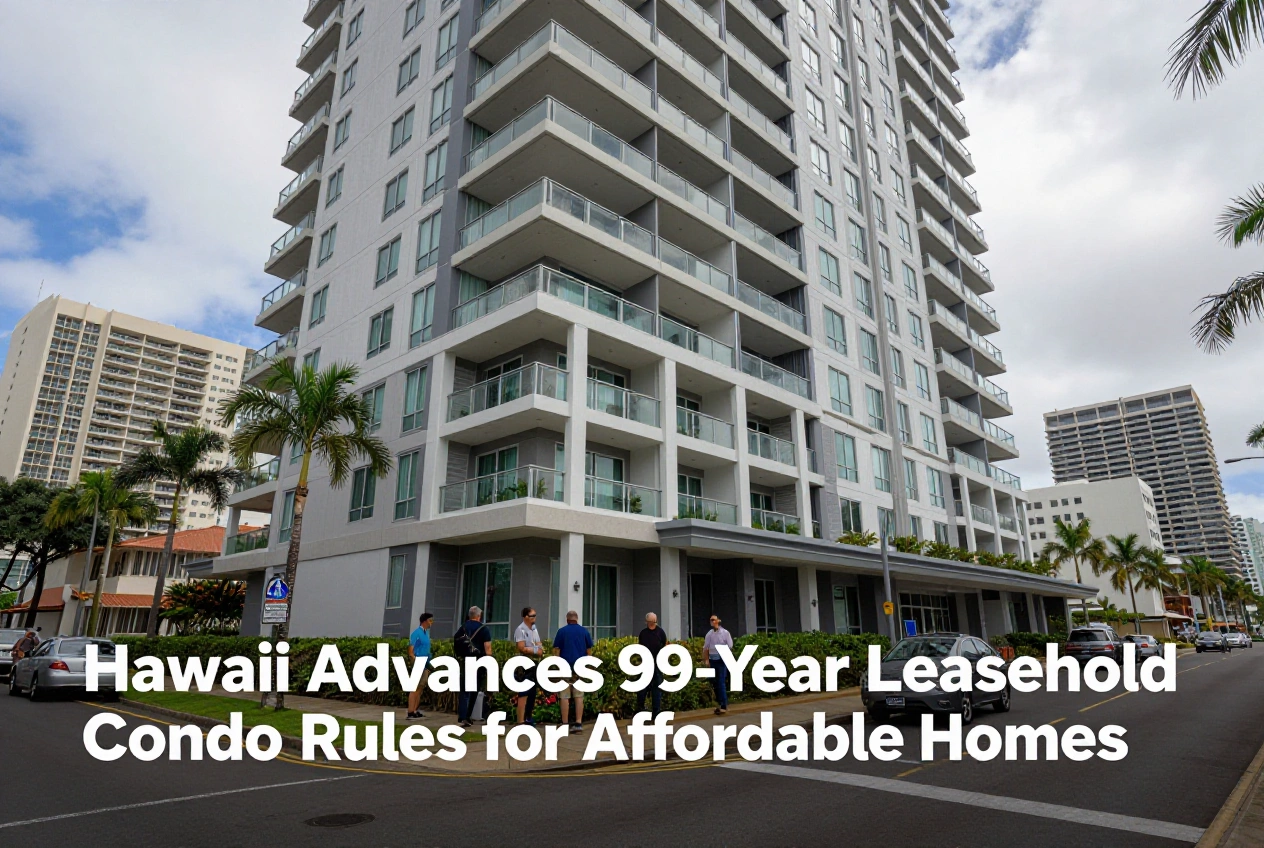
Hawaiʻi Advances Rules for 99-Year Leasehold Condominium Program
Hawaiʻi is moving ahead with proposed administrative rule changes for its Ninety-Nine Year Leasehold Condominium Program, an initiative designed to create lower-cost leasehold condominium homeownership opportunities for Hawaiʻi residents on state-owned land.
The Hawaiʻi Community Development Authority (HCDA) held a public presentation hearing on October 7, 2026, to receive input on proposed amendments to Hawaiʻi Administrative Rules Chapter 15-223, which governs the program. A separate decision-making hearing is scheduled for December 2, 2026.
The proposed rule changes follow Act 121, Session Laws of Hawaiʻi 2026, which amended the statutory framework for the 99-year leasehold program and directed HCDA to establish additional rules governing eligibility, sales, owner occupancy, income restrictions and resale pricing.
Why This Matters to Hawaiʻi Homebuyers
The 99-year leasehold program is intended to provide another path to homeownership by allowing qualifying residential condominium units to be developed on public land without requiring buyers to purchase the underlying land outright.
HCDA originally established the pilot program under Act 97 of the 2023 legislative session. The agency says the program is intended to determine the feasibility of developing low-cost leasehold residential condominium units on non-ceded state-owned land in urban redevelopment areas, particularly locations near public transportation.
Because the buyer leases the land rather than purchasing it, the structure can potentially reduce the upfront cost of acquiring a home. However, leasehold ownership also comes with specific restrictions and resale conditions that buyers need to understand.
What Act 121 Changes
Act 121 revised several parts of the 99-year leasehold program.
Among the changes, the law:
- Requires HCDA to establish an initial sales period during which units are offered to eligible buyers for owner-occupied residential use.
- Allows HCDA to establish rules governing how long owner-occupancy requirements apply.
- Allows certain unsold market-rate units to eventually be sold to other buyers without an owner-occupancy requirement, subject to conditions established by HCDA rules.
- Requires HCDA to adopt rules requiring at least 60% of residential condominium units to be income restricted.
- Requires HCDA to establish buyback pricing rules similar to pricing formulas used by other state housing agencies.
- Allows HCDA to regulate renting or other uses of units through administrative rules rather than relying solely on the statutory prohibition that existed previously.
The changes are intended to make the leasehold model more workable while preserving a significant portion of the project for income-qualified households.
Income Restrictions and Owner Occupancy
The 60% income-restricted requirement is an important part of the revised program.
HCDA has previously described its planned Kakaʻako pilot as a 370-unit mixed-income development, with 60% of the units reserved for households earning no more than 140% of area median income. The project is planned for the corner of Kapiʻolani Boulevard and Ward Avenue.
The revised framework also changes how owner occupancy works.
During the initial sales period, the units are to be offered for owner-occupied residential use to eligible buyers. Under the framework described by HCDA, if market-rate units remain unsold after the applicable period, up to 40% of the market units may eventually be sold to Hawaiʻi residents without the same owner-occupancy requirement, subject to the final administrative rules.
This represents a significant change from the original program structure, which imposed much stricter owner-occupancy requirements.
The Kakaʻako Pilot Project
The proposed rules are particularly relevant to HCDA’s planned 370-unit Kakaʻako leasehold condominium project.
The agency acquired two properties totaling approximately 26,626 square feet at the corner of Ward Avenue and Kapiʻolani Boulevard for the pilot development. The project is being developed by Ko Laila LLC and includes both reserved and market-rate housing as well as commercial space.
HCDA previously paused the project because of concerns about buyer interest, construction costs, market conditions and the restrictions associated with the original leasehold structure.
After Act 121 changed the program, HCDA said the project could resume. The agency has indicated that presales could begin in the first quarter of 2027, although that timeline remains subject to project and market conditions.
What Buyers Should Understand About Leasehold Ownership
A 99-year leasehold is different from conventional fee-simple ownership.
Under fee-simple ownership, the buyer owns both the home and the underlying land. Under a leasehold arrangement, the buyer acquires an interest in the residential unit while the underlying land remains owned by another party and is leased for a specified period.
The program is therefore designed to lower the land-related cost of homeownership, but buyers must also consider the lease terms, occupancy requirements, resale restrictions and any applicable buyback provisions.
The proposed HCDA rules are intended to establish clearer procedures for these issues, including eligibility, marketing and sales, resale or transfer, enforcement and foreclosure.
October 7 Hearing Was Not the Final Rule Adoption
An important distinction for potential buyers is that the October 7 hearing did not represent final approval of the amended rules.
HCDA’s official notice identifies October 7 as the Presentation Hearing. The agency has scheduled a separate Decision-Making Hearing for December 2, 2026, when the proposed amendments can move toward final consideration.
That means specific eligibility requirements, marketing procedures, resale provisions and other details should be confirmed against the final rules once they are adopted.
What This Could Mean for Hawaiʻi’s Housing Market
The program gives the state another mechanism for creating homeownership opportunities on public land without selling the land itself.
HCDA has described the Kakaʻako project as a pilot that could potentially provide a model for other public-land housing developments. However, the current program is limited in scope, and the success of the pilot will depend on construction costs, financing, buyer demand and the final regulatory framework.
It would therefore be premature to describe the program as a solution to Hawaiʻi’s broader housing affordability challenges. Instead, it represents one additional approach being tested by the state.
Practical Takeaway
For prospective buyers, the most important development is that Hawaiʻi is moving toward a revised regulatory framework for 99-year leasehold condominiums, but the rules are not yet final.
Residents interested in the program should monitor HCDA announcements and the December decision-making hearing for the final requirements.
Potential buyers should also carefully review the final lease terms, income requirements, owner-occupancy rules, resale restrictions and buyback provisions before purchasing a leasehold unit.