
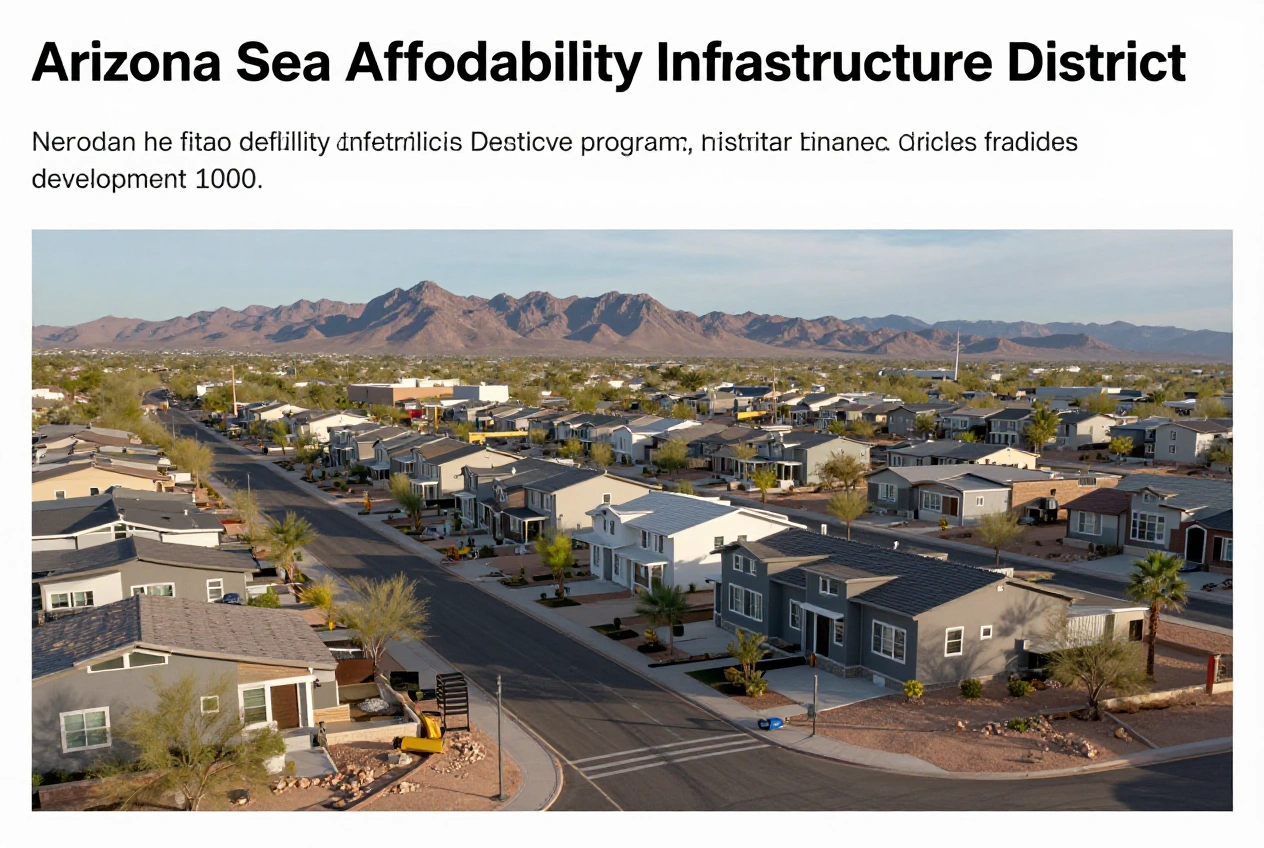
Arizona’s New SAID Act Opens Infrastructure Financing Opportunities for Housing Developers
Arizona | November 2026
Arizona has officially launched its new State Affordability Infrastructure District (SAID) program, creating another financing option for developers seeking to build housing and mixed-use communities across the state.
Signed into law by Governor Katie Hobbs on June 4, 2026, through House Bill 2999, the State Affordability Infrastructure District Act became effective September 14. The Arizona Finance Authority (AFA) officially launched the program on September 17 and is now accepting applications from eligible property owners seeking to establish districts.
The initiative is designed to help address one of the major challenges facing new development: the high upfront cost of building essential public infrastructure.
By allowing qualifying districts to use tax-exempt bond financing for infrastructure projects, Arizona aims to make development more financially manageable and support the delivery of additional housing.
However, the program also creates financial obligations that can affect properties within an established district, making it important for prospective buyers and homeowners to understand how it works.
What Is the SAID Act?
The State Affordability Infrastructure District Act establishes a statewide mechanism for financing public infrastructure before or alongside new development.
Under the legislation, a SAID is a special-purpose political subdivision of Arizona that can finance, construct, operate, and maintain eligible public infrastructure.
The program is administered through the Arizona Finance Authority, which reviews formation petitions and determines whether proposed districts satisfy the statutory requirements.
Eligible infrastructure projects may include:
- Roads and street improvements.
- Water distribution systems.
- Wastewater and sewer facilities.
- Public utilities and related infrastructure.
- Public safety facilities.
- Other qualifying public infrastructure supporting development.
The primary objective is to reduce the amount of capital developers must provide upfront to install essential infrastructure.
Rather than requiring all infrastructure expenses to be paid before construction begins, a qualifying district can use municipal bond financing to spread eligible costs over time.
Although housing affordability is the central legislative purpose, SAIDs are not limited exclusively to residential developments. Qualifying mixed-use projects involving commercial, retail, office, industrial, recreational, and civic uses may also benefit.
How the SAID Program Works in Practice
The Arizona Finance Authority has established a formal process for landowners seeking to create a district.
Unlike some traditional special districts, which may involve local government formation procedures, a SAID formation petition is submitted directly to the AFA.
The process generally involves the following steps:
1. Landowners organize the proposed district
All individuals and entities holding fee-title ownership of property within the proposed district boundaries must sign the formation petition.
The proposed district may include contiguous or qualifying noncontiguous parcels, subject to statutory geographic requirements.
2. Developers prepare the required documentation
The petition must include supporting information covering the proposed infrastructure, engineering estimates, financing arrangements, land ownership, and other statutory requirements.
The AFA currently organizes these requirements into 17 supporting exhibits, identified as Exhibits A through Q.
3. The petition is submitted to the Arizona Finance Authority
The AFA reviews the application and determines whether the statutory requirements have been satisfied.
The current application process includes a nonrefundable $15,000 review fee.
4. The district receives a formation order
If the petition satisfies the applicable requirements, the AFA Executive Director can issue a formation order.
The district must then complete the required recording and organizational procedures before moving forward with its financing and infrastructure activities.
The process is designed to establish a consistent statewide framework for qualifying development projects.
Important Financial Requirements and Responsibilities
One of the most important aspects of the SAID Act is how infrastructure financing is structured.
A qualifying district can issue and sell bonds to finance eligible public infrastructure. These bonds may use tax-exempt municipal financing mechanisms, potentially allowing infrastructure costs to be spread over longer periods.
However, the financing does not come without obligations.
Under the legislation, a SAID may have authority to levy certain property taxes, assessments, and liens within the district to support its financial obligations.
The law provides that the financial obligations of the district are borne by the properties within the district rather than automatically becoming liabilities of the state, Arizona Finance Authority, or surrounding municipalities.
The current AFA formation requirements also include a certified engineering statement showing that the estimated cost of constructing or acquiring the proposed public infrastructure exceeds $5 million.
This means the program is intended for substantial infrastructure projects rather than small neighborhood improvements.
For property owners and prospective homebuyers, understanding the financing structure is essential before purchasing property within a proposed or established district.
What the SAID Act Could Mean for Arizona Homebuyers
The program could support additional residential development by helping developers address the upfront costs associated with roads, water systems, sewer infrastructure, and other public facilities.
In areas where infrastructure costs have delayed planned developments, this financing option may help projects move closer to construction.
Potential benefits for homebuyers could include:
- More housing projects moving forward.
- Additional residential development opportunities.
- Infrastructure being installed earlier in the development process.
- Improved access to utilities and public facilities.
- Potential support for mixed-use communities and neighborhood growth.
However, these are potential long-term benefits, not guaranteed outcomes.
The program does not automatically lower home prices or guarantee that newly developed properties will be affordable.
The actual effect will depend on project costs, financing terms, infrastructure requirements, construction schedules, and the overall housing market.
Prospective buyers should also determine whether a property is located within an established SAID and whether applicable taxes, assessments, or other district obligations affect the property.
What Developers and Property Owners Should Consider
For developers, the SAID framework introduces another option for financing the public infrastructure needed to support larger residential and mixed-use projects.
However, establishing a district involves substantial preparation and professional review.
Developers should consider:
1. Infrastructure planning
Projects need a detailed infrastructure plan covering roads, utilities, public facilities, engineering requirements, and anticipated construction costs.
2. Landowner participation
All fee-title owners within the proposed district boundaries must participate in the formation petition. Coordinating ownership interests and securing the necessary documentation is therefore an important early step.
3. Financing and repayment
Developers and landowners should understand how proposed bonds, taxes, assessments, and other financial obligations will be structured.
4. Local government coordination
Although the AFA administers the state-level formation process, local governments remain important in development planning, infrastructure coordination, and applicable permitting requirements.
5. Professional advice
Legal counsel, bond professionals, financial advisors, engineers, and other qualified specialists may be needed to prepare the formation petition and evaluate the project’s financing structure.
Why This Matters to Arizona Homeowners and Community Associations
The SAID Act is particularly relevant to homeowners and community associations because infrastructure financing can influence how new residential developments are planned, constructed, and financially maintained.
For HOA boards, community managers, and prospective homeowners, several areas deserve attention.
1. Property taxes and special assessments
Properties within a SAID may be subject to district-related taxes, assessments, and liens supporting infrastructure obligations.
These costs should be understood separately from regular HOA assessments, property taxes imposed by other taxing authorities, and other community expenses.
2. New residential development
The availability of infrastructure financing could help move certain housing developments forward by reducing the amount of upfront capital required for public improvements.
This may contribute to new neighborhoods and mixed-use communities in growing parts of Arizona.
3. Infrastructure and community amenities
Roads, water systems, wastewater facilities, and public safety infrastructure are important to the long-term operation of residential communities.
HOA boards should understand which facilities are publicly maintained and which responsibilities may belong to the association.
4. Financial planning for homeowners
Prospective buyers should review applicable property disclosures and understand whether a property falls within a SAID boundary.
Any district-related financial obligations should be considered when evaluating the total cost of homeownership.
5. Long-term neighborhood growth
Developments supported by SAID financing may influence surrounding land use, traffic patterns, utility demand, and local infrastructure planning.
Community associations should monitor nearby projects and participate in relevant public planning discussions when appropriate.
The SAID Act does not automatically change HOA governing documents or association assessment requirements. Its significance is primarily related to how qualifying public infrastructure is financed and how financial obligations are allocated to properties within a district.
Frequently Asked Questions
1. What does SAID stand for in Arizona?
SAID stands for State Affordability Infrastructure District. It is a special-purpose political subdivision created under Arizona’s HB 2999 to finance qualifying public infrastructure supporting housing and other developments.
2. When did the SAID Act become operational?
HB 2999 was signed on June 4, 2026, and became effective September 14, 2026. The Arizona Finance Authority officially launched the program on September 17 and is accepting formation petitions.
3. What types of infrastructure can a SAID finance?
Eligible public infrastructure can include roads, water and sewer systems, public utilities, public safety facilities, and other qualifying improvements supporting development.
4. Does the SAID Act provide free funding to developers?
No. SAIDs can use bond financing to fund eligible infrastructure, but those financial obligations must be repaid. The district may impose taxes, assessments, and liens on properties within its boundaries as authorized by law.
5. Can a homeowner be affected by a SAID?
Yes. A property located within an established district may be subject to applicable district-related financial obligations. Buyers should review property disclosures and obtain information about any existing or proposed district assessments.
6. Is the SAID program only for affordable housing?
No. Although housing affordability is a primary purpose, qualifying mixed-use developments involving residential, commercial, retail, office, industrial, recreational, and civic uses may also benefit.
7. Where can developers find SAID application information?
Developers and landowners can access formation petitions, application instructions, FAQs, and other program information through the Arizona Finance Authority’s official SAID portal.
The Takeaway
Arizona’s SAID Act creates a new statewide infrastructure-financing option designed to help developers address the upfront costs of building roads, utilities, and other public facilities needed to support new development.
With the Arizona Finance Authority now accepting formation petitions, the program has moved from legislative approval to practical implementation.
For developers, the framework may provide another way to finance qualifying infrastructure and advance projects. For homebuyers and existing property owners, however, it is equally important to understand the potential taxes, assessments, and other financial obligations associated with properties located within an established district.
For Arizona homeowners and community associations, following SAID developments will be useful as new residential and mixed-use projects move through the planning and financing process.
This article is for general informational purposes only and is not legal, tax, or financial advice. SAID formation, financing, taxes, and assessments are subject to Arizona law and project-specific requirements. Prospective buyers and property owners should consult qualified professionals and review applicable property disclosures.