
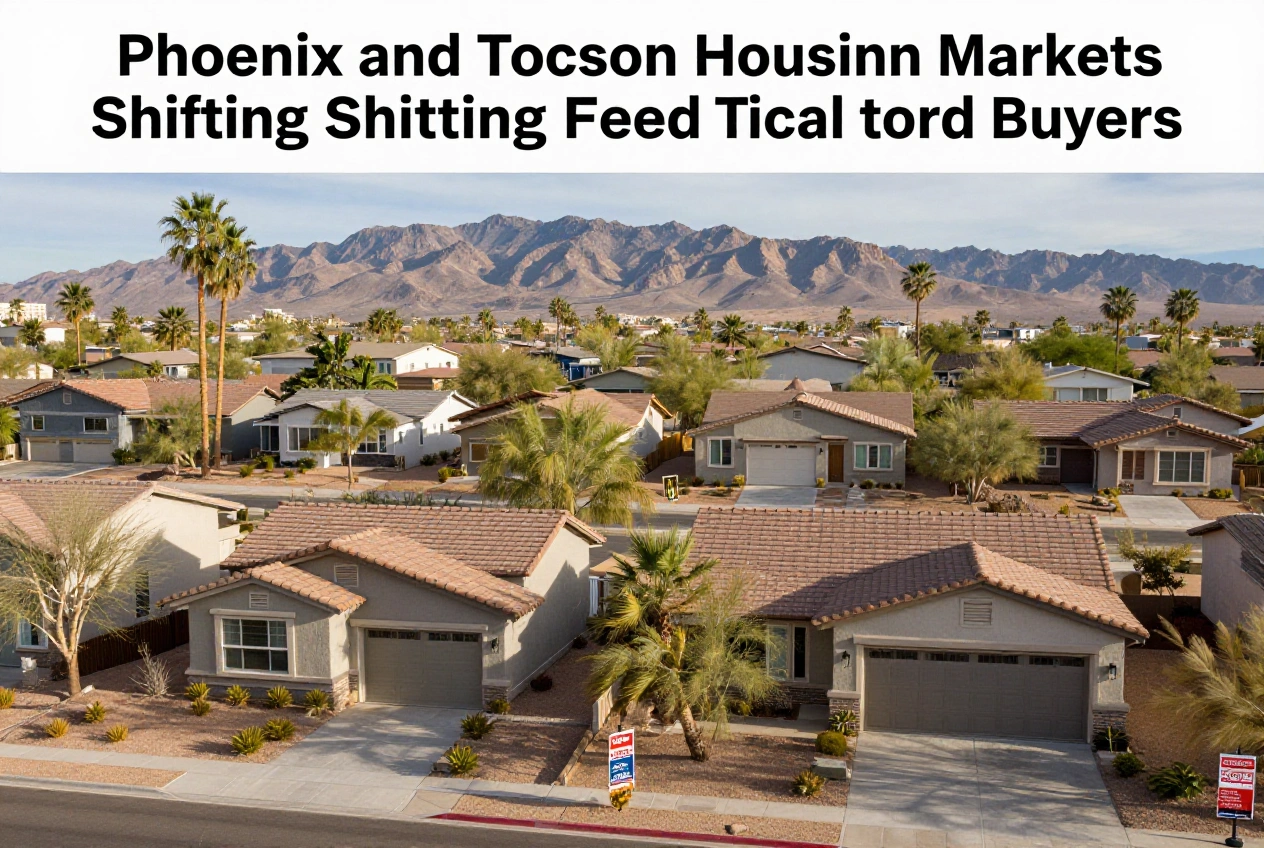
Phoenix and Tucson Housing Markets Shift Toward Buyers as Inventory Rises
ARIZONA — November 17, 2026 — Homebuyers in Phoenix and Tucson are seeing more opportunities to negotiate as housing inventory expands, sales activity slows, and sellers face increased competition. Recent market reports indicate that both metropolitan areas are moving toward more balanced conditions that favor buyers, although neither has been classified as an outright buyer’s market by Realtor.com.
The changing conditions may interest Texas residents considering relocation, second homes, or real estate investments in Arizona. More available properties can give buyers additional choices and time to compare prices, but elevated mortgage rates continue to create affordability challenges.
For sellers, the shift means that competitive pricing and realistic expectations are becoming increasingly important.
Realtor.com Market Clock Signals a Shift
According to Realtor.com’s third-quarter 2026 Market Clock report, Phoenix-Mesa-Chandler and Tucson both received a reading of 4 o’clock, placing them in the category of late balanced markets that are loosening.
This classification indicates that market conditions are moving toward buyers, with less competition and potentially greater negotiating flexibility than during seller-dominated periods.
However, a 4 o’clock reading does not mean that either market has officially become a buyer’s market. It indicates a transition in market conditions rather than a decisive advantage for one side.
The report also found that 49 metropolitan areas were classified as balanced and loosening, while 17 were categorized as buyer’s markets. This broader pattern suggests that more housing markets are moving away from the intense seller advantages experienced in recent years.
Metro Phoenix: Inventory Reaches Nearly 28,000 Homes
The Phoenix housing market continued to soften in October, according to the Arizona Regional Multiple Listing Service (ARMLS).
Its November 12, 2026, STAT report, which covers October activity, showed that active residential inventory reached 27,980 listings, a 9.6% increase from the previous year.
Other key figures included:
- Median sales price: $440,000, down 2.2% year over year.
- Average sales price: $613,903, up 4.7%.
- Closed sales: Down 17.2% year over year.
- Listings under contract: Down 19.7%.
- Months of supply: 6.04 months, compared with 4.72 months a year earlier.
The difference between average and median prices is worth noting. The average sales price increased while the median declined, partly reflecting changes in the mix of properties sold. Higher-priced transactions can lift the average even when the middle-priced home is selling for less.
The increase in available inventory, combined with fewer completed sales and pending contracts, indicates that buyers have more options and sellers are facing a slower market.
Cromford Market Index Shows Buyer-Favorable Conditions
Another important indicator is the Cromford Market Index, which measures the balance between supply and demand in the Greater Phoenix housing market.
The October market update reported an index of 70.1, compared with 78.8 a year earlier. Under the index’s commonly used thresholds, readings below 90 indicate buyer-favorable conditions.
This suggests that buyers have gained leverage across the broader Phoenix market. However, the index is a separate measure from Realtor.com’s Market Clock and should not be treated as the same classification.
Individual neighborhoods and price ranges can still experience different levels of demand.
City-Level Snapshot: Phoenix, Scottsdale, Gilbert, and Chandler
Although the regional market is moving toward buyers, conditions vary across Greater Phoenix.
October city-level figures reported by AZ Big Media show differences in median prices and marketing times among four major communities.
| City | Closed sales | Median sales price | Average days on market |
|---|---|---|---|
| Phoenix | 1,034 | $470,000 | 68 |
| Scottsdale | 325 | $1.1 million | 83 |
| Gilbert | 185 | $605,000 | 76 |
| Chandler | 178 | $513,000 | 59 |
Scottsdale remained the highest-priced market among the four communities, with a median sales price of approximately $1.1 million. Its longer average marketing time suggests that buyers may have more time to evaluate properties and negotiate.
Phoenix recorded the largest number of transactions, while Chandler had the shortest average marketing period among the four cities.
These figures demonstrate why buyers should examine local conditions rather than rely only on metropolitan averages. A home in Scottsdale may face a different level of competition from a similarly priced property in Phoenix or Chandler.
Mortgage Rates Continue to Challenge Affordability
While buyers may have more negotiating power, financing costs remain an important part of the housing equation.
Freddie Mac reported that the average 30-year fixed mortgage rate reached 7.40% on October 8 and October 15, 2026. Rates subsequently declined, with the weekly average falling to 7.24% on October 29 and 7.11% on November 12.
Although the recent decline provides some relief, borrowing costs remain elevated compared with the same period last year.
Higher mortgage rates can reduce the amount buyers qualify to borrow and increase monthly payments. As a result, even buyers who negotiate a lower purchase price need to consider the total cost of ownership.
Before making an offer, prospective buyers should compare mortgage options and account for property taxes, homeowners insurance, maintenance, and any applicable homeowners association assessments.
What the Market Shift Means for Texas Buyers and Investors
For Texas residents considering Arizona, the current market may offer an opportunity to explore properties with less pressure than during stronger seller-market conditions.
Phoenix and Tucson offer different housing options, price ranges, and lifestyles. Buyers comparing the two metropolitan areas should consider more than purchase price alone.
For relocating homeowners: More available listings can provide additional choices and flexibility when comparing neighborhoods, schools, commute times, and housing costs.
For second-home buyers: A slower market may allow more time for property inspections, financing arrangements, and negotiations before committing to a purchase.
For real estate investors: Higher inventory and slower sales may create opportunities to evaluate properties more carefully. However, investors should assess rental demand, operating expenses, insurance, property taxes, financing costs, and potential maintenance obligations.
For sellers: Homes may take longer to attract buyers if they are priced above comparable properties. Competitive pricing, property presentation, and a realistic marketing strategy are increasingly important.
For homeowners associations: Changes in home sales and property values can influence community turnover, homeowner expectations, and long-term planning. Associations should continue monitoring reserve funding, insurance expenses, maintenance needs, and assessment levels.
Texas buyers should also compare Arizona’s local property taxes, insurance costs, and community association requirements with those in their current locations. A lower purchase price does not necessarily translate into lower overall ownership costs.
Phoenix and Tucson Are Not Moving at the Same Pace
Although Realtor.com places both metropolitan areas in the same Market Clock category, their local housing conditions are not identical.
Phoenix has a larger and more varied housing market, with significant differences between communities such as Scottsdale, Gilbert, Chandler, and individual Phoenix neighborhoods.
Tucson also has its own supply and pricing patterns. Realtor.com’s October report showed 4,237 active listings in the Tucson metropolitan area, up 6.3% year over year. Its median listing price declined 2.6% to approximately $375,000, while 24% of active listings had price reductions.
These figures suggest that Tucson buyers are also seeing more choices and some room for negotiation.
However, the Phoenix and Tucson market indicators use different data sources and measurements. The October ARMLS figures describe closed sales and inventory across the Greater Phoenix MLS area, while Realtor.com’s Tucson report focuses on listing-market indicators. They should not be compared as though they were identical measurements.
Frequently Asked Questions
Are Phoenix and Tucson officially buyer’s markets?
Not according to Realtor.com’s third-quarter 2026 Market Clock. Both received a 4 o’clock reading, indicating late balanced conditions that are loosening toward buyers. The separate Cromford Market Index indicates buyer-favorable conditions in Greater Phoenix.
Are home prices falling in Phoenix?
ARMLS reported that the October 2026 median sales price was $440,000, down 2.2% year over year. However, the average sales price increased 4.7% to $613,903. This difference highlights how the mix of homes sold can affect market statistics.
Is Scottsdale becoming more affordable?
Scottsdale’s October median sales price was approximately $1.1 million, and homes averaged 83 days on the market. Longer marketing times may create negotiating opportunities, but the city remains considerably more expensive than Phoenix overall.
Are mortgage rates still above 7%?
Yes. Freddie Mac reported an average 30-year fixed mortgage rate of 7.11% on November 12, 2026. Rates have declined from October’s 7.40% level but remain above 7%.
Is Tucson also moving toward buyers?
Yes. Realtor.com’s Q3 Market Clock placed Tucson in the late balanced, loosening category. Its October market report also showed increased active listings and a lower median listing price compared with the previous year.
Should Texas residents consider buying in Arizona now?
The current conditions may provide more opportunities to compare properties and negotiate. However, buyers should evaluate their financial position, financing costs, local housing expenses, and the specific neighborhood before making a decision.
Practical Takeaway for Buyers and Sellers
The latest housing reports show Phoenix and Tucson moving toward more balanced conditions as inventory increases and sales activity slows. Buyers may have more choices and greater flexibility when negotiating, while sellers may need to adjust pricing and marketing strategies to remain competitive.
For Texas residents considering a move or investment in Arizona, the current environment provides an opportunity to research both markets carefully. Still, the best decision will depend on the property’s location, price, financing terms, and long-term ownership costs.
As 2026 draws to a close, buyers should focus on neighborhood-level data and total affordability rather than relying solely on broad market labels. Sellers and community associations should also continue monitoring local housing trends as conditions evolve.
This article is for general informational purposes only and does not constitute financial, mortgage, legal, tax, or real estate advice. Housing market conditions vary by location, property type, and price range. Buyers and sellers should consult qualified local real estate and financial professionals before making property decisions.